


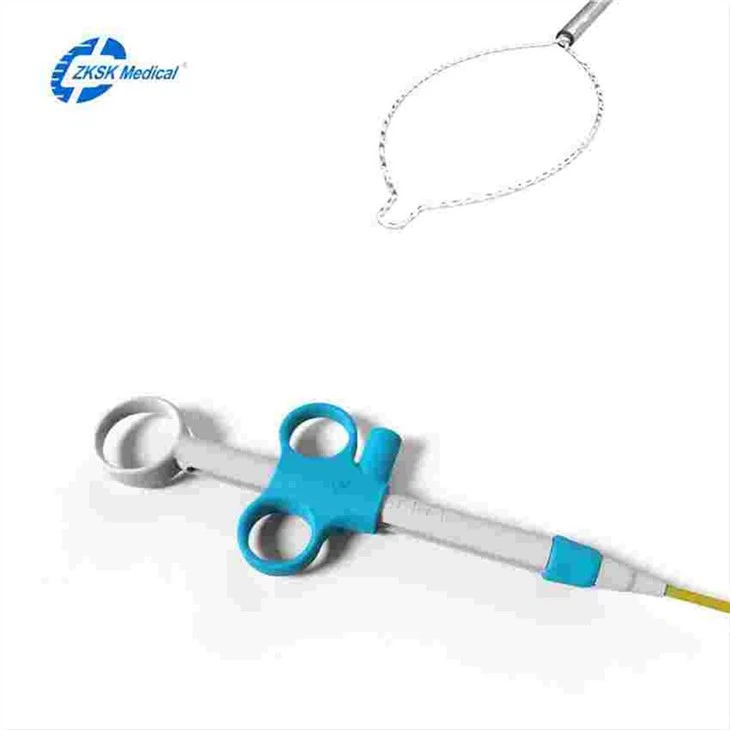

Disposable Polypectomy Snare Oval
Pic. 1 Device Drawing
1. Cutting Loop 2. Connector 3. Traction Wire 4. Sheath 5. Sheath Sleeve 6. Rotating Sleeve 7. Wire pusher 8. Electrode Connector 9. Slider 10. Handle

Pic. 2 Cutting Loop Shape

|
Loop Shape |
Model No. |
Sheath O.D (mm) |
Loop Width (mm) |
Working Length (mm) |
|
Ellipse (E type) |
ES18-E1810/2400 |
Φ1.8 |
10 |
2400 |
|
ES18-E1815/2400 |
Φ1.8 |
15 |
2400 |
|
|
ES18-E1810/1800 |
Φ1.8 |
10 |
1800 |
|
|
ES18-E1815/1800 |
Φ1.8 |
15 |
1800 |
|
|
ES18-E2410/2400 |
Φ2.4 |
10 |
2400 |
|
|
ES18-E2415/2400 |
Φ2.4 |
15 |
2400 |
|
|
ES18-E2410/1800 |
Φ2.4 |
10 |
1800 |
|
|
ES18-E2415/1800 |
Φ2.4 |
15 |
1800 |
|
|
ES18-E2425/1600 |
Φ2.4 |
25 |
1600 |
|
|
ES18-E2425/2400 |
Φ2.4 |
25 |
2400 |
|
|
ES18-E2432/2400 |
Φ2.4 |
32 |
2400 |
|
|
ES18-E2425/1800 |
Φ2.4 |
25 |
1800 |
|
|
ES18-E2432/1800 |
Φ2.4 |
32 |
1800 |
|
|
Hexagonal (H type) |
ES18-H2410/2400 |
Φ2.4 |
10 |
2400 |
|
ES18-H2415/2400 |
Φ2.4 |
15 |
2400 |
|
|
ES18-H2422/2400 |
Φ2.4 |
22 |
2400 |
|
|
ES18-H2432/2400 |
Φ2.4 |
32 |
2400 |
|
|
ES18-H2410/1800 |
Φ2.4 |
10 |
1800 |
|
|
ES18-H2415/1800 |
Φ2.4 |
15 |
1800 |
|
|
ES18-H2422/1800 |
Φ2.4 |
22 |
1800 |
|
|
ES18-H2432/1800 |
Φ2.4 |
32 |
1800 |
|
|
Crescent (C type) |
ES18-C2415/2400 |
Φ2.4 |
15 |
2400 |
|
ES18-C2425/2400 |
Φ2.4 |
25 |
2400 |
|
|
ES18-C2432/2400 |
Φ2.4 |
32 |
2400 |
|
|
ES18-C2415/1800 |
Φ2.4 |
15 |
1800 |
|
|
ES18-C2425/1800 |
Φ2.4 |
25 |
1800 |
|
|
ES18-C2432/1800 |
Φ2.4 |
32 |
1800 |
|
|
Round (R Type) |
ES18-R2432/2400 |
Φ2.4 |
32 |
2400 |
|
ES18-R2432/1800 |
Φ2.4 |
32 |
1800 |
Disposable Polypectomy Snare oval, the endoscopist advances the snare sheath, opens the snare and encircles the polyp. The snare is then slowly and progressively closed, with the aim of capturing 1-2 mm of normal tissue around the polyp, then use Electrocoagulation until complete closure is achieved and the polyp is guillotined. The polyp can then be suctioned and retrieved for histologic assessment.
Procedure: Disposable Polypectomy Snare Oval
Disposable Polypectomy Snare oval, which is using electrocoagulation on the basis of using cold snare.After HSP, another independent endoscopic surgeon judged whether the endoscopic eradication was successful. Afterward, additional EMR was performed at the polypectomy site to evaluate for the presence of residual polyp tissue, including an additional 1 to 2 mm clear margin, was resected by the snare and Endocut current after submucosal injection of a mixed solution. In the event that no tissue could be removed or if EMR failed to get in situ mucosal specimens. At least four cold biopsies using forceps on the remaining margins were obtained. After each procedure, the polypectomy site was observed for 30 seconds to confirm the absence of immediate bleeding, the specimens were retrieved and stored in formalin. Cross-sections of the EMR specimens were collected at 1-mm intervals; accurate tissue section of the marked site was ensured.
Colorectal cancer (CRC) is the third most common cancer in the US with 135 – 420 new cases per year 1. Screening colonoscopy with polypectomy substantially reduces CRC incidence and mortality 2 3. However, an unexpected high rate of incomplete resection of colon polyps has been reported in some recent studies, and this has in turn been related to a higher risk of post-colonoscopy interval CRC 4. Diminutive (< 5 mm) and small (6 – 9 mm) polyps represent the vast majority of polyps removed at screening colonoscopy 5. In theory, two major techniques are available for these lesions, namely biopsy-forceps polypectomy and snare polypectomy. The former, however, has been associated with a much higher rate of incomplete resection, especially for small polyps, and its use is not generally recommended 6. The latter may be further classified into hot (HSP) and cold (CSP) snare polypectomy. The basic difference is the use of a high frequency generator for HSP. Such use may, on the one hand, minimize immediate post-polypectomy bleeding by coagulation, but, on the other, it may also damage deeper vessels with increased risk of delayed bleeding 7 8 or even perforation. For this reason, CSP is usually considered safer, while resulting in equivalent rates of complete resection, and its use has dramatically increased in recent years 9 10 11 12, due also to the development of specific CSP-snares. CSP- and HSP-incomplete resection rates (IRR) for ≤ 10 mm polyps range widely, being 0.5 – 6.4 % and 1.2 – 7.4 %, respectively 12 13 14 15, and these estimates are much lower compared with forceps-polypectomy 6 16. However, any advantage of one technique (HSP vs. CSP) over the other remains unclear 17.
Popüler Etiketler: disposable polypectomy snare oval, China disposable polypectomy snare oval manufacturers, suppliers
Bir çift
Polipektomi Sıcak SnareSonraki
ÜcretsizBunları da sevebilirsiniz


Soruşturma göndermek